Skip to content
Site navigation Search
/chemistry-and-biosciences/research/microbiology/
Warning: include(/efs/www.brad.ac.uk/htdocs/navigation.php): failed to open stream: No such file or directory in /web/terminalfour/htdocs/chemistry-and-biosciences/research/microbiology/index.php on line 667

Warning: include(): Failed opening '/efs/www.brad.ac.uk/htdocs/navigation.php' for inclusion (include_path='.:/usr/share/pear:/usr/share/php') in /web/terminalfour/htdocs/chemistry-and-biosciences/research/microbiology/index.php on line 667

Microbiology and Biotechnology

Understanding Infectious Diseases

Microbiology research at the University of Bradford is focussed on understanding how certain bacterial pathogens can cause disease, and investigating the way in which colonisation of people and medically important inert surfaces can be reduced.

Our team in Bradford come from a range of interdisciplinary backgrounds, with plenty of experience both of academic study and hands on expertise in clinical hospitals. We contribute to the biomedical science teaching and research by providing insight into a broad fauna of bacterial species both infectious and passive. We are keen to better understand and treat a range of complex infectious organisms.

We are also working on biological sensors and other biotechnological devices to treat, combat the spread of, or faster diagnose all manner of infections. 

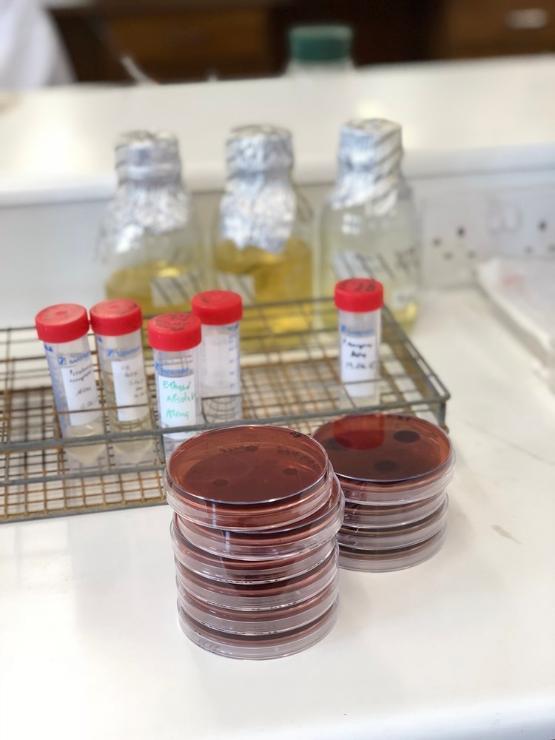
Microbiology Lab equipment

Standard microbiological lab bench

Prominent microbiology researchers within the school are:

Dr. Jonathan Fletcher

Associate Professor in Microbiology

Dr Jonathan Fletcher

Research Interests:

Current and previous research interests are in the investigation into the molecular basis of pathogenesis of Enteropathogenic and Enteroaggregative E. coli; Bioarchaeology and microbial decomposition of tissues particularly of fats; H. influenzae in ocular infection.
 

Keywords: Bacterial Pathogenicity; E. coli; Gastro-Intestinal Infections; Bioarchaeology


Contact

Email
j.fletcher@bradford.ac.uk
Phone
(01274) 233565
Dr Jonathan Fletcher

Associate Professor in Microbiology

Dr Maria Katsikogianni

Assistant Professor in Biomaterials

Dr Maria Katsikogianni

Name: Dr. Maria Katsikogianni

Research Interests:

Design of bio-inspired multifunctional materials with non-fouling/antimicrobial properties for a number of applications; medical, environmental

Characterisation Expertise:

Material physicochemical and mechanical characterisation; contact angle measurements and surface energy evaluation, Scanning Electron Microscopy and Atomic Force Microscopy, roughness measurements, thermal analysis, drug release profiles

Orcid iD.: 0000-0002-1560-3993

Contact

Email
M.Katsikogianni@bradford.ac.uk
Phone
+44 (0) 1274 23 6185
Dr Maria Katsikogianni

Assistant Professor in Biomaterials

Kara Thornton

Assistant Professor in Microbiology

Microbiology Lab equipment

Works in partnership with Airedale Hospital, acting as an on site microbiologist to determine microbiological infections.

Contact

Email
K.Thornton2@bradford.ac.uk
Phone
+44 (0) 1274 234681
Microbiology Lab equipment

Assistant Professor in Microbiology

Studying Upset Stomach's

Gastro-intestinal infection, usually manifested as diarrhoea and/or vomiting, remains a major cause of global death, with up to 1 million people per year succumbing to the disease, the majority being young children in developing countries.

We have studied many different infective species that cause can gastro-intestinal disease, such as Escherichia coli - an almost ubiquitous member of the microflora of the healthy GI tract. E. coli has a number of strains and variants which have evolved to be pathogenic to humans. Enteropathogenic E. coli (EPEC). EPEC usually only cause disease in very young children, but it can be very severe and is often fatal. The bacteria adhere to the surface of the small intestine and causes changes to the structure and function of the cells lining the gut. This process is quite complicated, and involves multiple genes, our aim is to understand the roles of some of the identified but uncharacterised genes and proteins.

Another variant, Enteroaggregative E. coli (EAEC), causes milder, but more long lasting diarrhoea in children, but is also a significant cause of ‘Traveller’s Diarrhoea in adults.EAEC are a very heterogeneous group, and this leads to problems with their laboratory diagnosis. Whilst many tests are available, the only one which is absolutely reliable is a an adhesion assay using human cells grown in the lab, to which EAEC stick in a characteristic ‘stacked brick’ pattern. Our aim is to develop a cheaper, more convenient diagnostic test, with very good reliability.
Microbiology

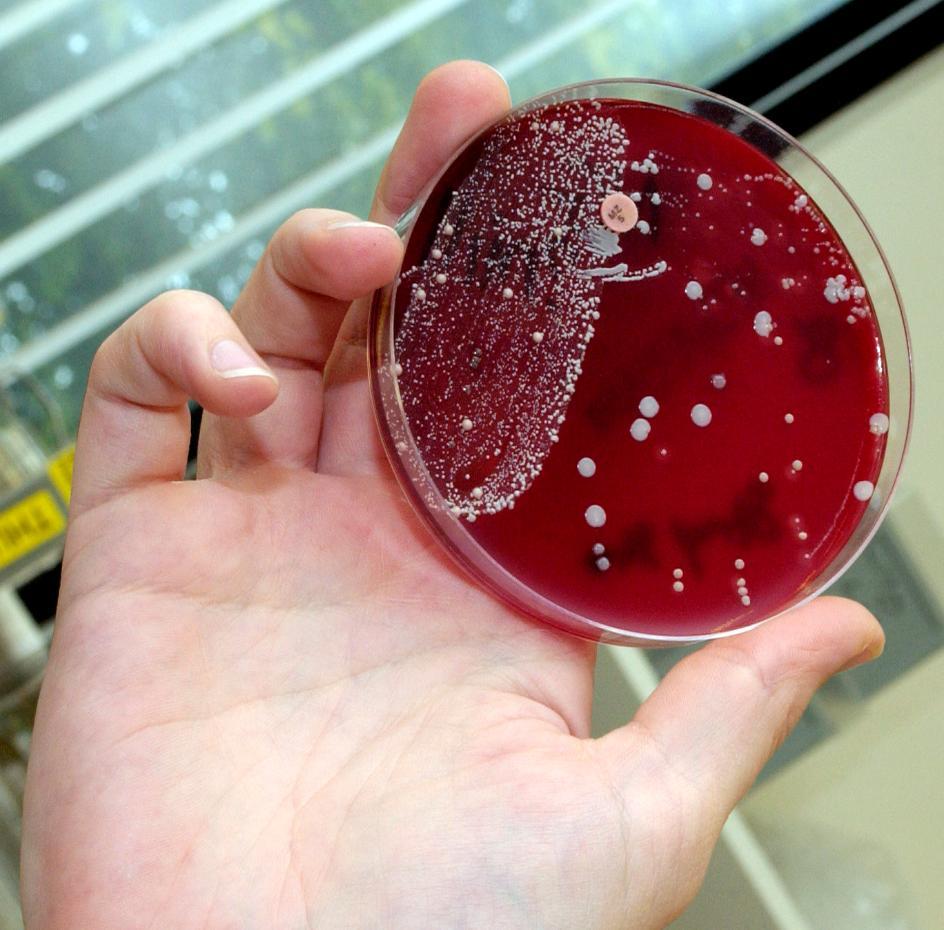
Bacterial culutre on an agar plate

Bacterial biofilm: the slimy city of bacteria

Biofilms are ubiquitous bacterial behaviours - when they collect bacteria forms large, organised structures. Within this biofilm bacteria are protected from external damages and attacks such as the immune systems or antibiotics. We are interested in investigating the key molecular mechanisms and gene regulatory networks for biofilm formation in response to the attachment on different material surfaces, and to find surfaces / methods of prevent them from forming.
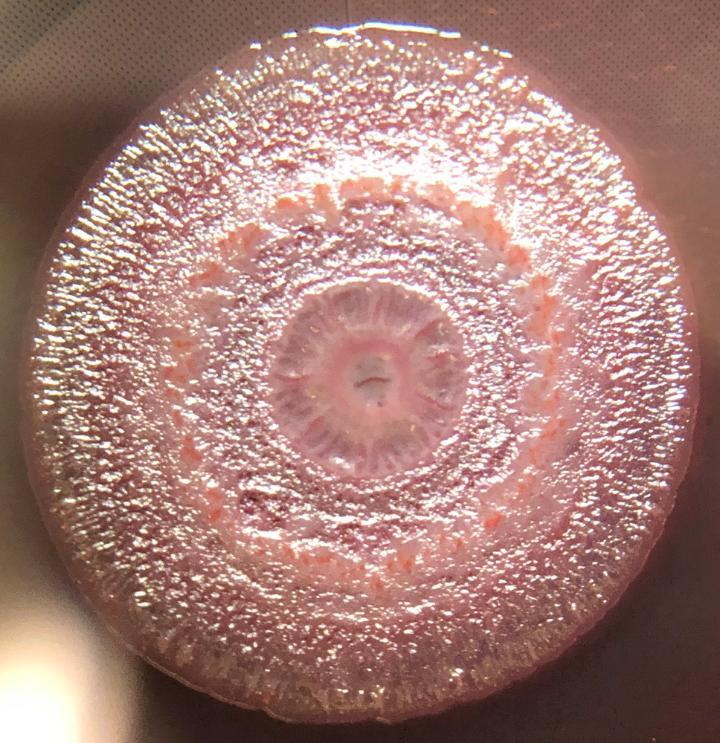
Pseudomonas biofilm

Photograph of Pseudomonas aeruginosa forming a biofilm

Bacteria 'speaking' to each other

Quorum sensing (QS) is coined to describe bacterial cell-cell communication by small signalling molecules. Through QS, bacterial population can coordinate their population behaviours including biofilm formation, virulence production and antibiotics resistance. Our work focuses on understanding molecule mechanisms of bacterial communication and QS-regulated networks for virulence expression and will facilitate the development of novel therapeutic approaches against bacterial infections.
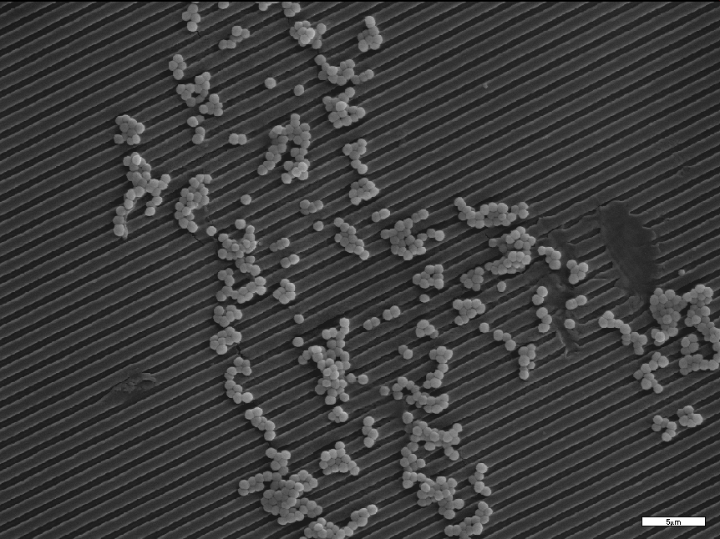
Bacteria on surface

Scanning electron microscope of bacteria on a patterned surface designed to prevent them sticking to it
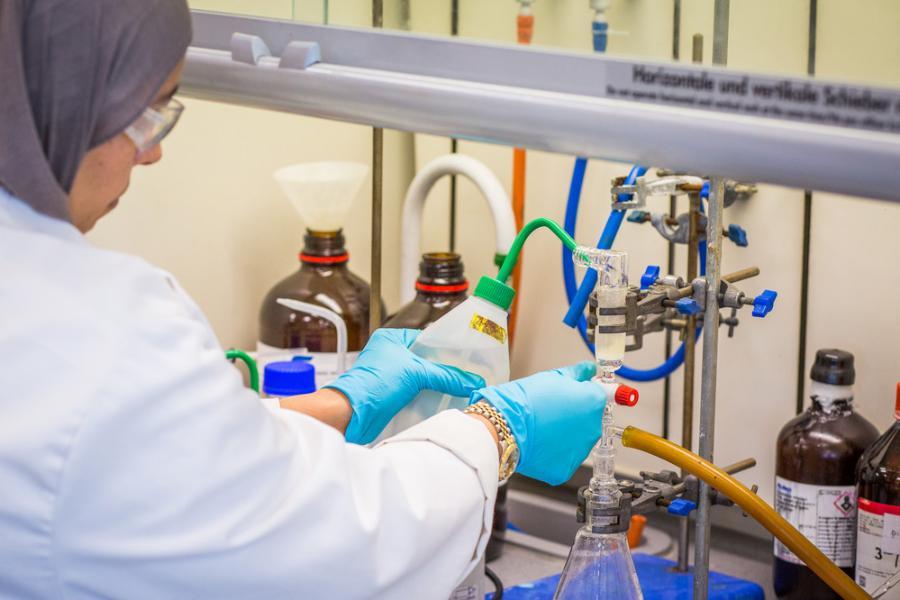
Polymers for Detection of Infection

Prof S. Rimmer, Dr W. Martin

Fume Hood

The increase in resistance of bacteria to antibiotics is one of the biggest issues facing the world and many commentators have written on the catastrophic effects of the descent into a post-antibiotic world. New therapies are clearly required to combat infectious diseases but also new diagnostic techniques are required to provide better understanding of infected states. This project addresses the latter by providing polymer materials that bind selectively to bacteria and then respond to their presence; by changing conformation.1-3 The change in conformation can then be assessed using dyes that are sensitive to their environment.

We will work in collaboration with microbiologists at the University of Sheffield, who will test the polymers in established microbiological assays. The key polymers are highly branched poly(N-isopropyl acrylamide)s with bacteria binding ligands at the chain ends. The ligand in this case is a peptide, VPHNPGLISLQG, which has been identified by phage display techniques to selectively bind to Staphylococcus aureus.

The project will mainly involve the synthesis of these polymers and their characterisation in terms of molecular structure and physical properties with their microbiological properties being assessed at University of Sheffield. We will also examine the toxicity of the polymers in cell culture assays at Bradford.

Entry requirements

A 2:1 MChem or MSc in Materials Chemistry or a related subject.

Funding

Applicants will need to have their own funding or external sponsorship. A bench fee may be payable in addition to the tuition fees.

Contact

Email
S.Rimmer@bradford.ac.uk; W.Martin@bradford.ac.uk
Fume Hood

Prof S. Rimmer, Dr W. Martin